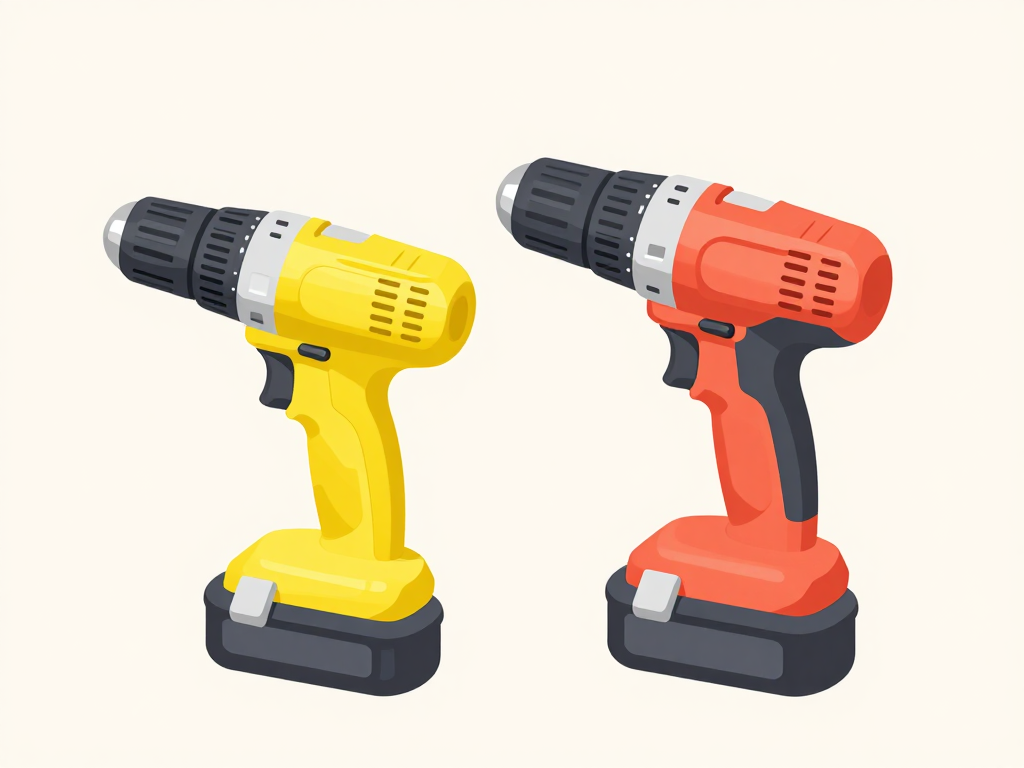
Short answer: M12 and M18 are two separate Milwaukee battery platforms — 12 volts and 18 volts — and they are not interchangeable. An M12 battery only fits M12 tools and chargers; an M18 battery only fits M18 tools and chargers. Neither platform is “better” outright: M12 is built for compact, lightweight, close-quarters work, while M18 is built for higher torque and heavier-duty tasks. Most tradespeople who own both systems chose M12 for precision/overhead work and M18 as their primary heavy-duty platform.
Milwaukee sells drills, drivers, saws and dozens of other tools under both the M12 and M18 names, and the shared “M” branding leads a lot of buyers to assume the batteries cross over. They don’t. This guide lays out exactly where the line is, using only Milwaukee’s own published specifications.
Are M12 and M18 batteries interchangeable?
No. Milwaukee states directly that all M18 batteries are compatible with M18 tools and chargers, and all M12 batteries are compatible with M12 tools and chargers — batteries are not interchangeable across the two systems, only within each one. The battery footprint, the tool’s electrical contacts, and the charger cradle are all sized differently between the two platforms, so an M12 pack will not physically seat in an M18 tool or charger, and vice versa.
What’s the actual voltage difference?
M12 tools run on M12 REDLITHIUM batteries rated at 12 volts. M18 tools run on M18 REDLITHIUM batteries rated at 18 volts. That 50% voltage gap is the reason the two platforms exist side by side rather than one replacing the other — M12 trades raw power for a smaller, lighter package, while M18 uses the extra voltage headroom for higher-torque and higher-runtime tools.
How much more power does M18 actually deliver?
Milwaukee’s own product pages give a useful side-by-side using each platform’s flagship compact 1/2″ drilling tool:
| M12 FUEL 1/2″ Drill/Driver (3403-20) | M18 FUEL 1/2″ Hammer Drill/Driver (2904-22 kit) | |
|---|---|---|
| Battery voltage | 12V (M12 REDLITHIUM) | 18V (M18 REDLITHIUM) |
| Max torque | 400 in-lbs | 1,400 in-lbs |
| Chuck | 1/2″ all-metal | 1/2″ all-metal, carbide teeth |
| Weight / length | 2.5 lbs | 6.9″ length (weight not published) |
| Included battery example | 2.0Ah compact / 4.0Ah extended | XC5.0 Extended Capacity (x2, in kit) |
Editorial note: these two models aren’t perfectly matched — the M12 model is a plain drill/driver and the M18 model adds a hammer-drill function — so treat the torque gap as “what each platform’s flagship compact drill delivers,” not a controlled spec-for-spec test. Still, a roughly 3.5x torque difference between the two flagship compact drills gives a realistic sense of the power gap between the platforms.
Which battery capacities are available?
Both platforms use Milwaukee’s REDLITHIUM battery line, just sized for different voltages. Milwaukee’s own battery-selection guide names, among others: the M12 CP2.0 (2.0Ah, compact) on the M12 side, and the M18 XC6.0 (6.0Ah) and M18 HD12.0 (12.0Ah) on the M18 side. Higher-Ah packs run longer between charges and generally sag less under heavy load, at the cost of extra weight — the same tradeoff that applies within any single voltage platform, not something specific to M12 vs M18.
Which platform should you buy into?
Editorial conclusion, not an official Milwaukee recommendation: M12’s size and weight make it a common choice for overhead work, tight cabinets, and anyone who wants a drill they can run one-handed all day. M18 is the platform to build a heavy-duty kit around — framing, decking, automotive, anything that regularly needs more than a couple hundred in-lbs of torque. Many trade users end up owning both: a compact M12 driver for finish work alongside an M18 kit for everything else. Buying into both means carrying two separate sets of batteries and chargers — that’s the real cost of the split, not a lack of options within either system.
Can you adapt an M12 battery to an M18 tool (or the other way around)?
Third-party adapters exist on the market, but no Milwaukee-published source reviewed for this guide approves using anything other than the matching battery family with each tool. Absent an official Milwaukee statement, this guide does not present cross-system adapters as approved or recommended — only as a product category that exists independently of Milwaukee.
Model-level compatibility matrix
State labels separate source-backed facts from gaps: CONFIRMED is explicit in a reviewed primary source; UNSUPPORTED is outside the cited scope; UNKNOWN is not established by the reviewed source.
| Pair or boundary | State | Evidence / reason |
|---|---|---|
| Milwaukee M12 battery ↔ M12 tool | CONFIRMED | M12 is Milwaukee’s 12V platform. |
| Milwaukee M18 battery ↔ M18 tool | CONFIRMED | M18 is Milwaukee’s 18V platform. |
| M12 battery ↔ M18 tool | UNSUPPORTED | The platform split prevents crossover. |
| Unspecified Milwaukee family | UNKNOWN | Family must be identified first. |
How this was checked
This comparison is based only on Milwaukee’s own published pages: the official battery/charger compatibility statement, Milwaukee’s battery-selection guide, and the individual product pages for the M12 FUEL 1/2″ Drill/Driver (3403-20) and the M18 FUEL 1/2″ Hammer Drill/Driver Kit (2904-22). No tool count, launch date, or weight figures are stated here beyond what those pages publish — where a source didn’t give a number, this guide doesn’t invent one.
Sources checked: 2026-08-05. A new review date will only be set after the linked pages are re-checked.