
Yes — according to Makita’s own MAKPAC Interlocking Cases landing page, MAKPAC is “Compatible with Festool®, Systainer® and other similar systems.” That is a remarkably direct claim, because across every storage system checked across all seven brands on this site, it is the only one where a manufacturer names a specific non-house competitor by name as officially compatible.
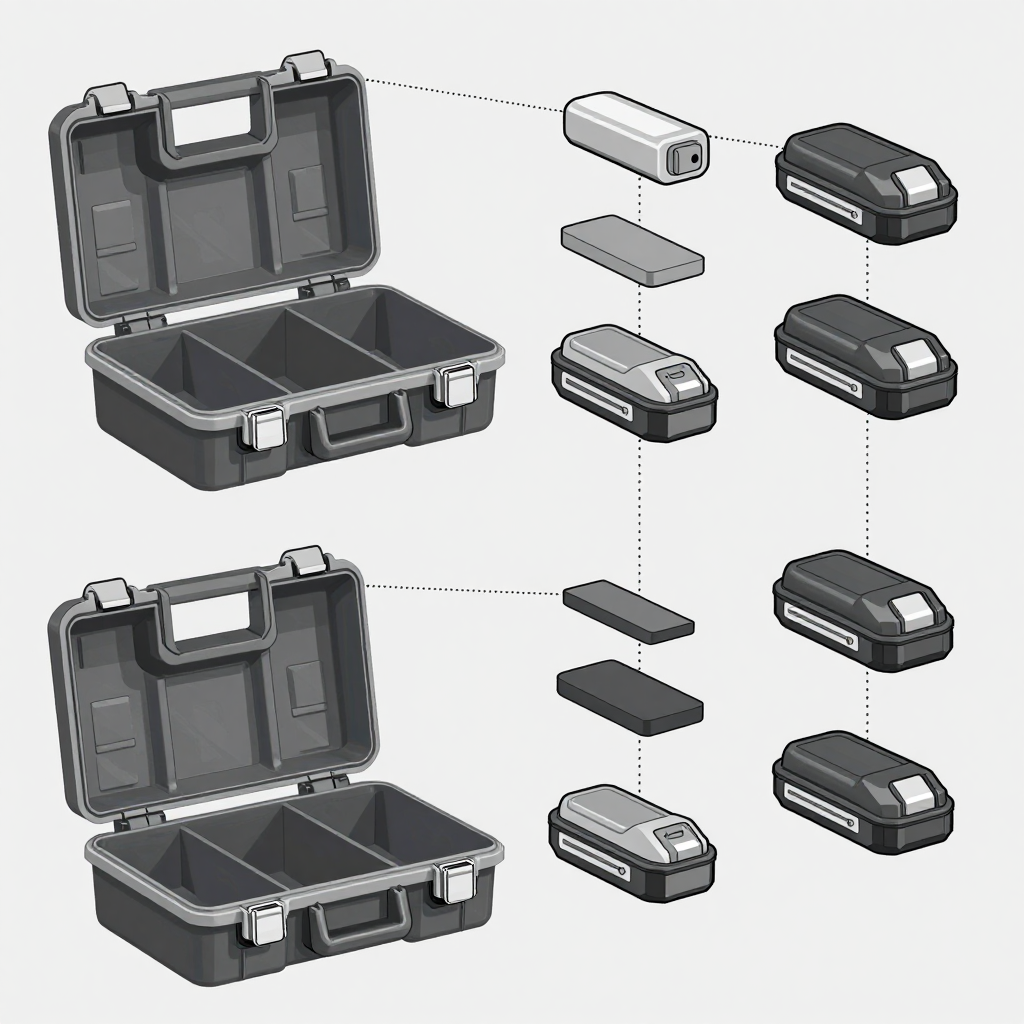
Makita describes MAKPAC as “a modular storage solution that can be conveniently stacked, linked and transported to wherever the job takes you,” with a latch system “engineered for stable, non-shift stacking and secure transportation” and “reinforced walls” for added strength. The Festool/Systainer line is not explained further — the page does not list which Festool Systainer models or generations fit, nor does it define what counts as “other similar systems.” So the claim is explicit, but its limits are not. Still, if your shop already runs Systainers, this is the clearest official cross-brand handshake found on any brand’s storage page.
The physical case design backs up the stacking idea. The Makita MAKPAC Case (197211-7) measures “6-1/2″ x 15-1/2″ x 11-5/8″” and carries a “Max. Weight Capacity: 44 lbs.” Its “interlocking latches” both “secure lid shut and link stacked cases together for efficient moving,” and Makita notes “corresponding channels along lid and base of case for stable, non-shift stacking.” The idea is a tower of cases that moves as one unit rather than a pile of boxes sliding around in a truck bed.
Where things get more interesting is the BCC01, Makita’s 40V max XGT and 18V LXT 8 Port Charging Case. This is not a passive storage box — it is a charging-and-storage hybrid with its own voltage story. Makita’s product page states it is “Compatible with all 40V max XGT battery sizes” and “Compatible with 18V LXT batteries with ADP10 battery adapter for each port (sold separately).” The ADP10 adapter is already covered elsewhere on this site, but the key point here is that the BCC01 is not natively dual-voltage: one adapter is required per port if you want to charge LXT batteries alongside XGT.
For throughput, Makita says the BCC01 “Charges up to 8 XGT batteries, cycling 4 at a time,” with “each bank of 4 batteries in as little as 90 minutes” when using 2.5Ah batteries. If you are setting up a charging station, Makita also notes that up to “4 charging boxes” can run “on a single dedicated 15A circuit without overloading,” charging “up to 32 batteries overnight.” That is a real number for fleet or crew use, not just a single-tradesman scenario.
One thing Makita does not appear to offer, at least based on what was found on its site, is a dedicated MAKPAC battery-only storage rack insert comparable to Milwaukee’s PACKOUT battery racks or RYOBI’s LINK Battery Shelf. The BCC01 is the closest sourced product, and it stores batteries by charging them. If you were hoping for a simple MAKPAC tray that just holds spare batteries in rows, that does not seem to exist in Makita’s current catalog.
So what does the Festool/Systainer claim actually mean in practice? If you already own Festool Systainer cases, Makita’s own page says MAKPAC should connect with them — genuinely useful if your shop already has a mixed-brand case collection, though Makita does not specify exact model compatibility, so it is worth a physical test-fit before committing to a full stack. For anyone deciding on the BCC01: it is a real convenience if you run both XGT and LXT batteries and want to charge up to 8 XGT (or LXT with ADP10 adapters) from one box, and multiple boxes can share one 15A circuit overnight — but budget for the ADP10 adapters separately if LXT charging is the goal, since they are sold separately per port.
How this was checked
Facts on this page are drawn from Makita’s own MAKPAC Interlocking Cases landing page, 40V max XGT and 18V LXT 8 Port Charging Case (BCC01), and MAKPAC Case (197211-7) product pages.
Sources checked: 2026-08-11. A new review date will only be set after the linked pages are re-checked.